Physics Fundamentals: 7 Easy Concepts with No Confusion and Powerful Results
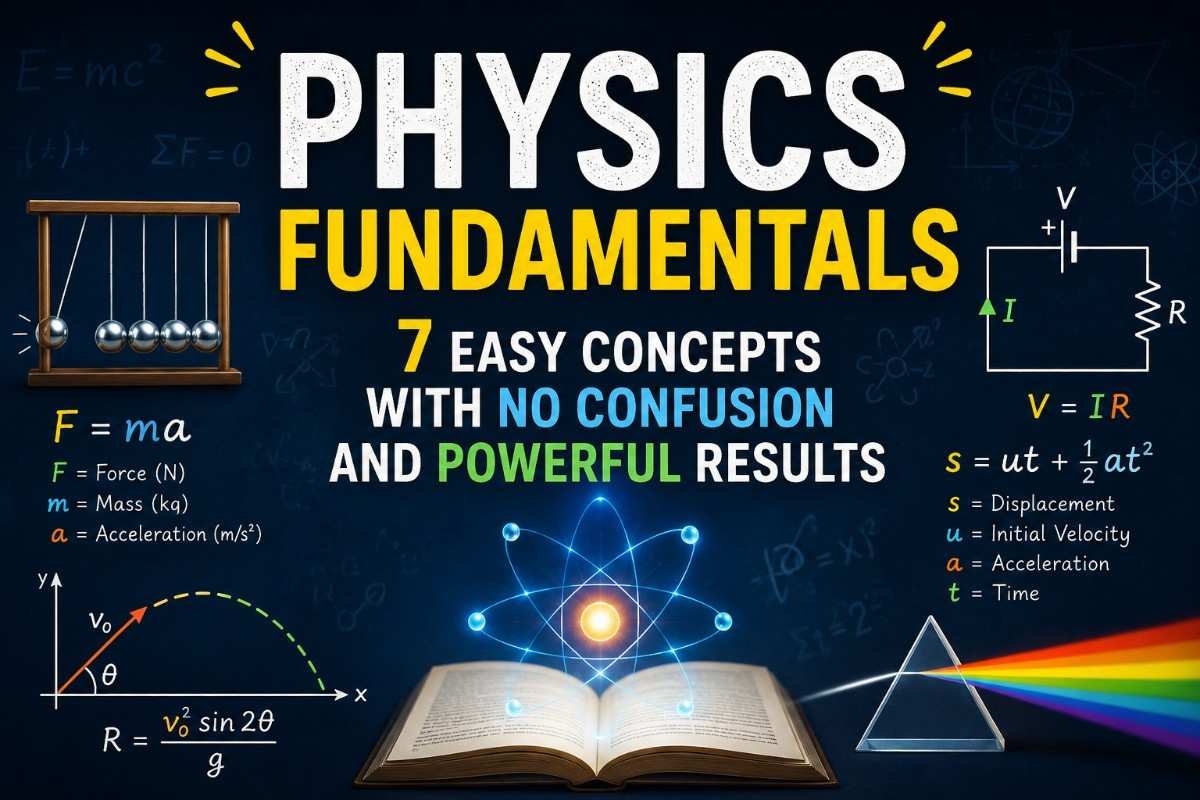
Physics is a science subject that explains how the world around us works. Everything from moving cars to aeroplanes follows the laws of physics. Physics Fundamentals helps students understand energy, force, matter, motion, gravity, and scientific laws in a simple way. This area develops analytical thinking and problem-solving skills. A bunch of modern technologies, such as computers, electrical systems, and smartphones, are based on physical concepts. Learning basic physics also helps students do better in science education and engineering studies. Understanding these fundamental scientific principles provides a strong, strong foundation for advanced learning and real-world applications.
What Are Physics Fundamentals?
The foundations of physics are the basic concepts and principles that explain natural events and physical systems. These concepts include motion, velocity, force, energy, mass, and gravity. Physics teaches how things behave and interact with each other. Students learn scientific methods, calculations, and logical thinking through these core topics. A basic understanding of physics can be useful in academics, technology, engineering, and everyday activities.
Branches of Physics Fundamentals
The study of the foundations of physics is divided into a bunch of branches. Classical physics explains motion, sound and energy. Modern physics focuses on atomic structure and quantum mechanics. Thermodynamics studies heat and temperature systems. Astrophysics explains the planets, stars and the universe. Atomic physics is the study of atoms and radiation. Each sector helps scientists discover new technologies and improve scientific knowledge.
Basic Concepts in Physics Fundamentals
Key concepts in basic physics include matter, energy, space, and time. Matter is anything that has mass and takes up space. Energy makes things work. Motion explains how objects move from one place to another. A force changes the direction or speed of an object. These concepts form the basis of scientific learning and a better, better understanding of the physical sciences.
Newton’s Laws in Physics Fundamentals
One of the important topics of the foundations of physics is Newton’s law of motion. The first law states that an object will remain at rest unless acted upon by a force. The second law links force, mass, and acceleration. The third law states that every action has an equal and opposite reaction. These laws are applied to vehicles, sports, engineering and transportation systems.
Force and Motion in Physics Fundamentals
Fundamentals of Physics explains different types of forces, such as gravity, friction, magnetic force and tension force. Motion describes how things move in speed and direction. Balanced forces keep things stable, while unbalanced forces create motion. Understanding force and motion helps students understand mechanics, transportation systems, and physical interactions in everyday life.
Energy and Work in Physics Fundamentals
Energy is an important part of fundamental physics because all activities require energy. Kinetic energy is related to motion, while potential energy is stored energy. Work is done when a force moves an object a distance. Performance measures how quickly work is done. These concepts are useful in machinery, electrical systems and industrial technology.
Electricity and Magnetism Basics
Electricity and magnetism are two fundamental topics in fundamental physics. Electricity flows through current and voltage systems. Conductors allow electrical current to move while insulators prevent it. Magnetism creates a magnetic field around objects. Electromagnetism is widely, widely used in motors, generators, communication devices and electronic technology.
Waves and Sound in Physics
Waves transfer energy from one place to another. Sound waves travel through the air and allow people to hear different sounds. Light waves help people see things around them. Frequency and wavelength affect the behaviour of a wave. These topics enhance the understanding of communication systems, music technology and optical devices.
Importance of Physics in Daily Life
Physics plays an important role in modern life. Transportation systems, medical equipment, construction projects, and electronic devices are based on the principles of physics. Cell phones, Internet technology, and electrical machines work because of scientific laws. Physics also helps improve energy production, environmental studies, and space exploration programmes.
Tips to Learn Physics Easily
Students learn physics more effectively by understanding concepts rather than memorising formulas. Practising numerical problems improves calculation skills. Viewing science experiments and diagrams makes learning easier. Regular review and solving of physics exercises helps students to gain self-confidence in science subjects. Simple study methods make physics easy for beginners.
Career Opportunities in Physics
Physics offers a bunch of career opportunities in engineering, research, space science, education and technology… Students with a strong knowledge of physics can work in robotics, artificial intelligence, renewable energy and data science. A career in science offers excellent growth opportunities in modern industries.
Advantages of Learning Physics
Studying physics develops logical thinking, critical analysis and problem-solving skills. Increases understanding of natural laws and scientific systems. Physics also supports innovation and technological development. Students who understand physics concepts do better in engineering and science careers.
Conclusion
In summary, Fundamentals of Physics provides the basic knowledge needed to understand the physical world and scientific principles… This topic introduces motion, force, energy, electricity, and a bunch of natural processes that affect everyday life. Physics develops the logical thinking, analytical and problem-solving skills of students and professionals. It also supports modern inventions, engineering systems and advanced technologies used around the world. By learning physics concepts step-by-step, beginners can build a strong educational foundation for future success in science, technology, and research-related careers.
(FAQs)
1. Why are the basics of physics important?
Fundamentals of Physics helps students understand the laws of nature, scientific systems and modern technology in everyday life.
2. What are the main topics of physics?
The main topics are force and motion energy, electricity, waves, gravity and thermodynamics.
3. Is physics difficult for beginners?
Physics becomes easier when students have a clear understanding of the concepts and practice numerical questions regularly.
4. How is physics used in everyday life?
Physics is used in transportation communication devices, electrical systems, medical technology and construction.
5. What professions can I choose after studying physics?
Students can choose careers in engineering education, astronomy research, robotics and technology.